


Do driving modes in the Cadillac Lyriq actually change range and battery use?

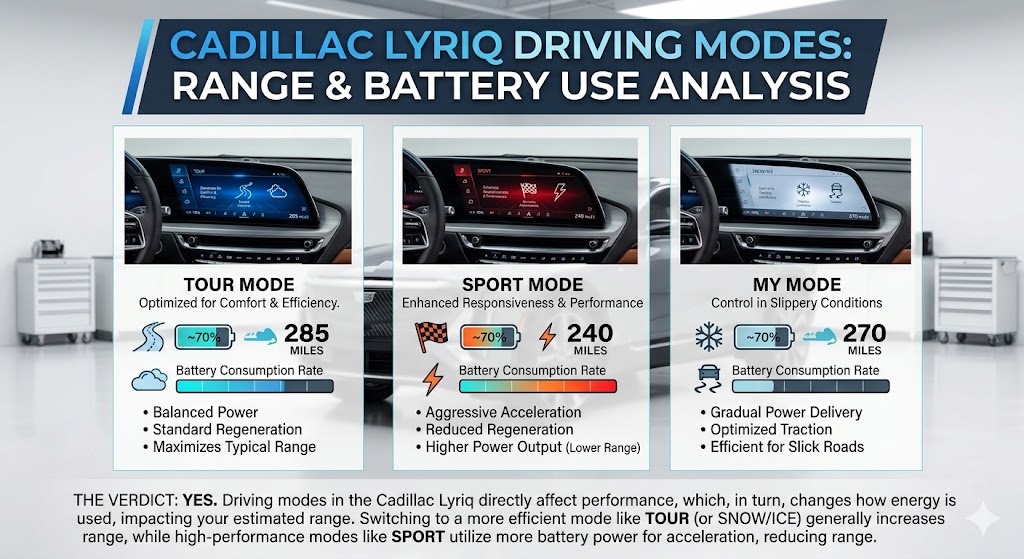
Yes. They do. But not in the way many people expect.
The battery itself does not change size or capacity, but the way power is used changes a lot. That difference directly affects how far you can drive and how quickly the battery drains.
This topic sounds simple, but most people misunderstand it. The real answer sits in how electric vehicles manage energy, not just how much battery they have.
What “driving modes” really do inside the Lyriq
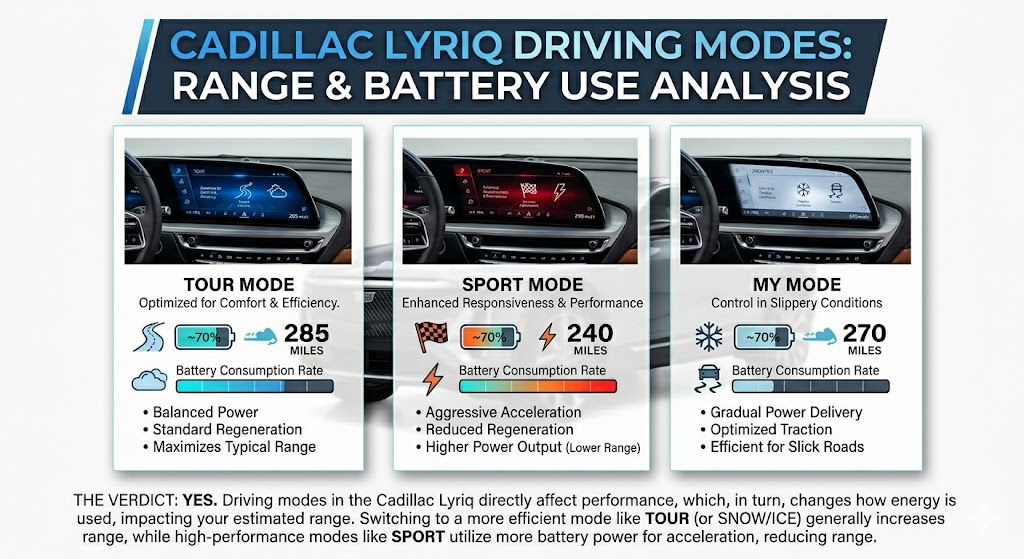
Driving modes are not magic switches that give you extra battery. They are software presets that change how the car behaves.
Each mode adjusts:
- Throttle sensitivity (how quickly power is delivered)
- Regenerative braking (how much energy is recovered)
- Motor power output
- Traction and stability control
- Steering feel
That combination changes energy consumption patterns, which then changes range.
Quick Explore of what changes
| Feature | Tour Mode | Sport Mode | Snow/Ice Mode | My Mode |
|---|---|---|---|---|
| Power delivery | Smooth | Aggressive | Limited | Custom |
| Energy efficiency | Highest | Lowest | Medium | Depends |
| Regenerative braking | Strong | Reduced | Moderate | Adjustable |
| Range impact | Best | Reduced | Slight drop | Variable |
The key idea: range is not fixed—it reacts to behavior.
The short, blunt answer about range differences
- Tour Mode = best range
- Sport Mode = lower range
- Snow/Ice Mode = slightly lower range
- My Mode = depends on your setup
And this is not just theory.
- Tour Mode can give maximum range near EPA estimate (~312–314 miles)
- Sport Mode can reduce range by 10–15% (around 30–45 miles lost)
- Snow/Ice Mode reduces range slightly (around 3–8%)
So yes—modes absolutely affect battery usage.
Understanding the baseline: what range the Lyriq starts with
Before talking about modes, you need a baseline.
The Lyriq has:
- Around 102 kWh battery capacity
- EPA range roughly 300–314 miles depending on version
That range is tested under controlled conditions. Real-world driving changes everything.
Original World range reality
| Condition | Approx Range |
|---|---|
| Ideal driving | ~300 miles |
| Aggressive driving | ~250–280 miles |
| High-speed driving | lower |
| Cold weather | significantly lower |
Driving mode sits on top of these factors.
Tour Mode: the efficiency-focused setting
Tour Mode is the default. It’s tuned for daily driving and long trips.
What makes Tour Mode efficient
- Smooth power delivery
- Strong regenerative braking
- Balanced motor output
- Less aggressive acceleration
These features reduce wasted energy.
What drivers actually experience
- Longer driving distance per charge
- Less battery drain in city traffic
- More predictable range
Estimated performance impact
| Metric | Tour Mode |
|---|---|
| Range | Maximum |
| Efficiency | Highest |
| Driving feel | Calm and smooth |
Research shows Tour Mode can give up to 8–10% more range compared to aggressive modes
Practical example
If your car shows 300 miles range:
- Tour Mode: ~300 miles possible
- Sport Mode: could drop to ~260–280 miles
That difference comes purely from how energy is used.
Sport Mode: performance at the cost of efficiency
Sport Mode is where most people lose range without realizing it.
What changes in Sport Mode
- Faster throttle response
- Higher motor output
- Reduced regenerative braking
- More aggressive acceleration
This means more power draw per second.
Why it drains more battery
Electric motors use the most energy during acceleration. Sport Mode encourages that behavior constantly.
Original world impact
| Metric | Sport Mode |
|---|---|
| Range | Reduced |
| Efficiency | Lower |
| Driving feel | Fast and responsive |
Studies suggest:
- 10–15% range reduction
- Roughly 30–45 miles lost per charge
Brutal truth
Sport Mode doesn’t just “feel faster”—it actually burns energy faster.
Snow/Ice Mode: stability over efficiency
Snow/Ice Mode is not about saving energy. It’s about staying in control.
What it changes
- Limits power output
- Adjusts torque delivery
- Keeps traction systems active
Why it affects range
- Constant traction control uses energy
- Power delivery is less efficient
- Wheels may slip slightly (energy loss)
Estimated effect
| Metric | Snow/Ice Mode |
|---|---|
| Range | Slightly lower |
| Efficiency | Moderate |
| Purpose | Safety |
Typical impact: 3–8% reduction in range
When to use it
Only in poor conditions. Using it in dry weather is inefficient.
My Mode: the wildcard setting
My Mode lets you customize:
- Steering
- Acceleration
- Regenerative braking
Why this matters
You can accidentally create:
- A very efficient setup
- Or a very inefficient one
Example configurations
| Setup | Result |
|---|---|
| Strong regen + soft throttle | Better range |
| Weak regen + sharp throttle | Worse range |
Reality check
Most drivers unknowingly set My Mode closer to Sport Mode than Tour Mode.
The hidden factor: regenerative braking
This is one of the most misunderstood parts.
What it does
When you lift your foot off the accelerator:
- The motor slows the car
- Energy is sent back into the battery
Why it matters
More regen = more recovered energy = better range
Mode comparison
| Mode | Regen Strength |
|---|---|
| Tour | High |
| Sport | Lower |
| Snow/Ice | Moderate |
| My Mode | Adjustable |
This is one of the main reasons Tour Mode is more efficient.
The bigger truth: driving behavior matters more than modes
Here’s where most people get it wrong.
Driving mode matters—but your habits matter more.
Factors stronger than driving modes
- Speed (huge impact)
- Acceleration habits
- Temperature
- Terrain
- Tire pressure
Example from real drivers
Higher speeds reduce range significantly
Going from 70 mph to 80 mph can cut range heavily.
Combined impact: mode + behavior
Let’s combine everything into a realistic picture.
Scenario comparison
| Scenario | Estimated Range |
|---|---|
| Tour + calm driving | ~300 miles |
| Tour + aggressive driving | ~270 miles |
| Sport + calm driving | ~280 miles |
| Sport + aggressive driving | ~250 miles or less |
Same battery. Completely different outcomes.
Does Sport Mode damage the battery?
No.
This is a common myth.
- The battery management system protects the battery
- Mode does not affect long-term battery health
What actually affects battery life
- Charging habits
- Temperature
- Keeping battery between 20–80%
Driving mode is not a major factor here.
User insights (from owners)
From community discussions:
- Range varies widely based on conditions
- Many drivers report near 300 miles in good conditions
- Cold weather and speed reduce range heavily
Practical tips to get maximum range in a Lyriq
Driving habits
- Accelerate slowly
- Maintain steady speeds
- Avoid high-speed driving
Mode usage
| Situation | Best Mode |
|---|---|
| Daily driving | Tour |
| Highway trip | Tour |
| Fun driving | Sport |
| Bad weather | Snow/Ice |
Smart techniques
- Use regenerative braking actively
- Avoid sudden stops
- Pre-condition the car while charging
Why EV modes matter more than gas cars
In gasoline cars:
- Driving modes mostly change feel
In electric cars:
- Driving modes directly change energy flow
That’s why the effect on range is real and measurable.
Bottom Line
Driving modes in the Cadillac Lyriq absolutely affect range and battery usage.
- They do NOT change battery capacity
- They DO change energy consumption
- That directly changes real-world range
If you care about range, stay in Tour Mode.
If you stay in Sport Mode regularly, expect noticeable range loss.
The biggest mistake people make is thinking modes are just for “feel.”
They’re not—they change how your battery gets used every second.